

Google AI Mode Hotel Booking Is A Visibility Warning
Google AI Mode hotel booking is no longer a distant travel idea. On August 27, 2026, Google said travelers in the U.S. can discover and book hotels inside AI Mode in English, with booking options tied to partners including Booking.com, Expedia, Hilton, IHG, Marriott, Priceline, Trip.com and Wyndham.
That matters because the search is turning into the shortlist. A family does not have to search “Denver family hotel,” open ten tabs, compare amenities, check parking, and then decide. They can describe the trip once and let the assistant narrow the field.
Are You Visible gets businesses found when their customers ask AI. I measure those answers across ChatGPT, Gemini and Perplexity, then show operators what is being said before they pay for the work.
What changed with Google AI Mode hotel booking?
Google AI Mode hotel booking moves hotel discovery closer to the transaction. Google says a traveler can tell AI Mode about a trip, see a visual list of hotels with reviews and comparison factors, then ask AI Mode to help complete the booking.
The hotel or booking platform still handles the booking and customer service. Google is not saying the assistant owns the whole reservation. But the important moment has already moved.
The traveler asks. The assistant filters. The property gets framed before the traveler reaches the booking path.
Why does the Denver result matter?
The Denver result shows how specific the new shortlist can become. The traveler asked for a hotel in Denver on November 11 for two adults and two children, with road trip access and accessibility in mind.
The answer did not return a generic hotel list. It named Drury Plaza Hotel Denver Central Park and gave concrete reasons: highway access, free self-parking, breakfast, an indoor-outdoor pool, and the evening food offer.
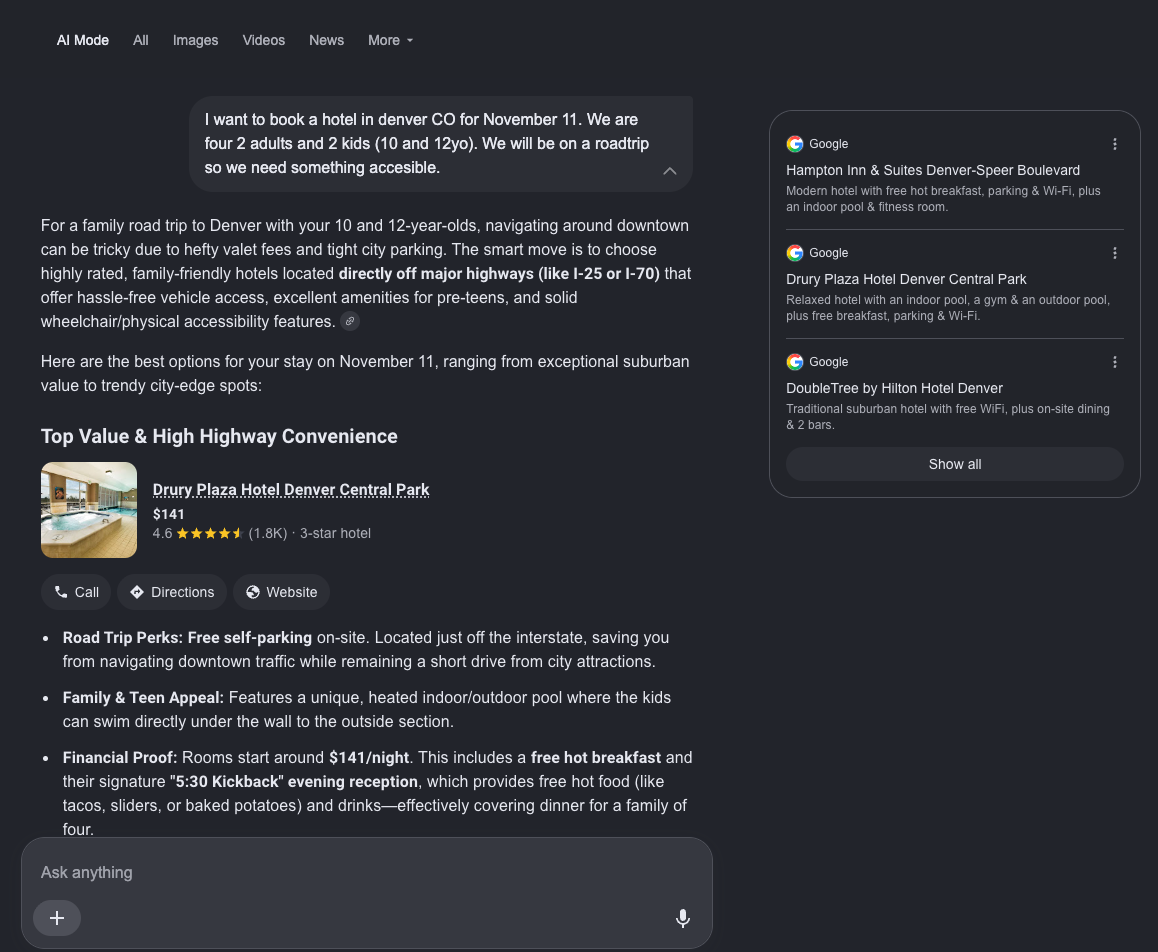
That is the part operators should stare at. The assistant did not just name a hotel. It explained why the hotel matched the trip.
A hotel absent from that answer is not only missing a rank. It is missing the reason a family uses to stop comparing.
What should hotel operators check now?
Hotel operators should check whether AI answers can understand the property for real traveler situations. Use a Temporary Chat when you test ChatGPT, because memory can influence the answer.
Ask like a guest, not like an owner. Try a query with city, date, party size, purpose, parking, accessibility, pet policy, loyalty points, or whatever actually matters to the booking.
Then read the names and the reasons. If another hotel is recommended because of parking, family amenities, reviews, location, or booking ease, that reason is the work.
The fix is not “write AI content.” The fix starts with cleaner public facts, stronger review language, clearer booking data, and proof that connects the hotel to the stay the guest described.
Sacha
August 31, 2026 · Issue #57
Sources
Google, “3 new ways to plan and book travel in Search,” August 27, 2026 - https://blog.google/products-and-platforms/products/search/book-travel-ai-mode/
Google for Developers, “Google Universal Commerce Protocol (UCP) for Lodging,” 2026 - https://developers.google.com/hotels/ucp
Amadeus, “Amadeus unveils major expansion of AI strategy across hospitality sector,” June 16, 2026 - https://amadeus.com/en/newsroom/press-releases/amadeus-unveils-major-expansion-ai-strategy-across-hospitality-sector
Correction policy. If anything in this post is wrong, I’ll fix it inline and add a Correction line above this notice with the date, what was wrong, what’s correct, and the source. No silent edits.
Go deeper
The AI Visibility Encyclopedia covers the full operational framework behind these signals, organic and paid, 48 chapters, free.
Read the encyclopedia →Published August 31, 2026