AI Ads Need an Organic Foundation
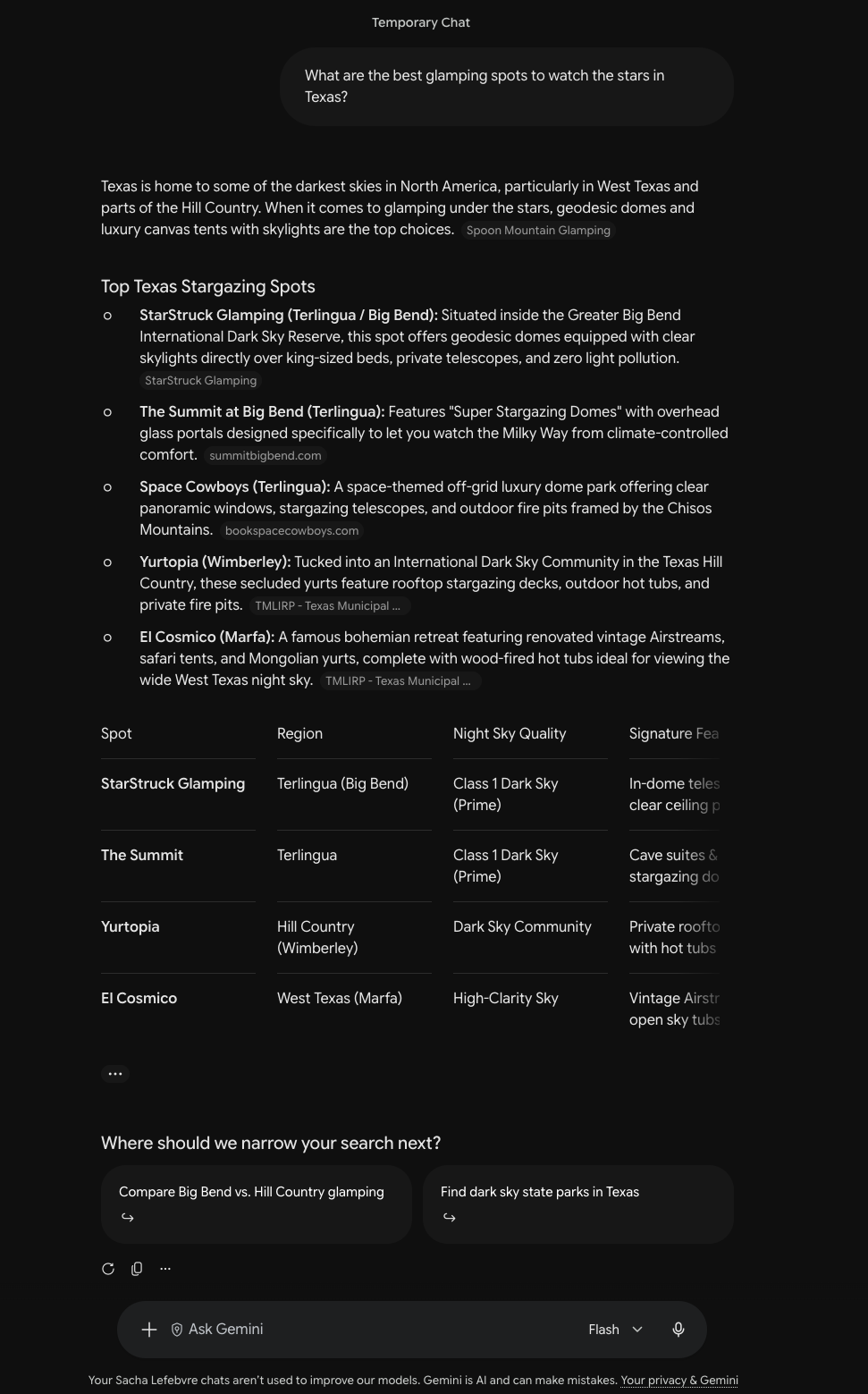
The screenshot is not about glamping.
It is about the order of the sale.
Someone asks a Temporary Chat, “What are the best glamping spots to watch the stars in Texas?” The answer does not begin with an ad slot. It begins with places the assistant can understand, sort, and explain.
Are You Visible is my AI search visibility agency. I get businesses found, cited, and recommended inside AI answers when their customers ask what to buy, who to hire, where to book, or which provider to trust.
Why does organic visibility matter before paid AI search?
Organic visibility matters before paid AI search because ads do not replace the need for a clear answer.
OpenAI says ad selection can consider the current conversation context and, when personalization is enabled, selected signals from a user’s broader ChatGPT activity. OpenAI also says OAI-AdsBot may visit an advertiser landing page for policy and safety checks, and that landing-page content may help determine when an ad is relevant.
That is not the same as saying ChatGPT reads the whole web around your brand before showing an ad.
The narrower point is stronger. If your landing page is vague, your category is unclear, and your proof is thin, you are asking a paid placement to do work your public pages should already be doing.
What does the Texas glamping answer show?
The Texas glamping answer shows how much useful detail an assistant needs before it can recommend a business.
The answer names StarStruck Glamping in Terlingua because the dark-sky location, domes, skylights, telescopes, and Big Bend setting all match the buyer’s request. It names The Summit at Big Bend because the lodging format and stargazing promise are easy to connect to the question. It names Yurtopia because Wimberley, rooftop decks, hot tubs, and dark-sky context make the fit obvious.
Now imagine paying to enter that kind of conversation with a page that only says “luxury outdoor stays in Texas.”
The assistant can still show an ad when the ad system decides it is relevant. But the organic answer has already taught the buyer what good looks like. Specific places. Specific reasons. Specific proof.
What should you check before buying AI ads?
Before buying AI ads, check the organic answer in a Temporary Chat.
Ask the buyer’s question, not your brand name.
Ask for the category, the use case, and the location. Then repeat the check across ChatGPT, Gemini, and Perplexity over several days. Look for the same pattern: who gets named, what reasons appear, which sources are cited, and which businesses keep missing.
If you are absent, paid may still be possible. But you are buying into a conversation where the assistant has not already learned why you belong.
That is not only a media problem.
It is a visibility problem.
What gets fixed first?
The foundation gets fixed first: the landing page, crawl access, category language, proof, reviews, and third-party sources that make the business easy to understand.
No guaranteed citations. No promised AI ranking. No promised number of mentions.
The controllable outcome is knowing where you stand, what is blocking you, and what has to change before the paid layer has to carry too much of the sale.
Saturday is the day I point you at the work.
Open the tiers and see how I fix the foundation before paid AI search has to carry the whole argument.
Sacha
September 12, 2026 · Issue #64
Sources
OpenAI, “Advertising on ChatGPT,” accessed September 9, 2026 - https://help.openai.com/en/articles/11456250-advertising-on-chatgpt OpenAI, “Overview of OpenAI Crawlers,” accessed September 9, 2026 - https://developers.openai.com/api/docs/bots
Corrections policy: If I get a fact wrong, I will correct the post and note the correction here.
Go deeper
The AI Visibility Encyclopedia covers the full operational framework behind these signals, organic and paid, 48 chapters, free.
Read the encyclopedia →Published September 12, 2026