
AI Reputation Management Is No Longer Optional
AI reputation management now includes the answer a buyer gets before they visit your site.
The screenshot is simple.
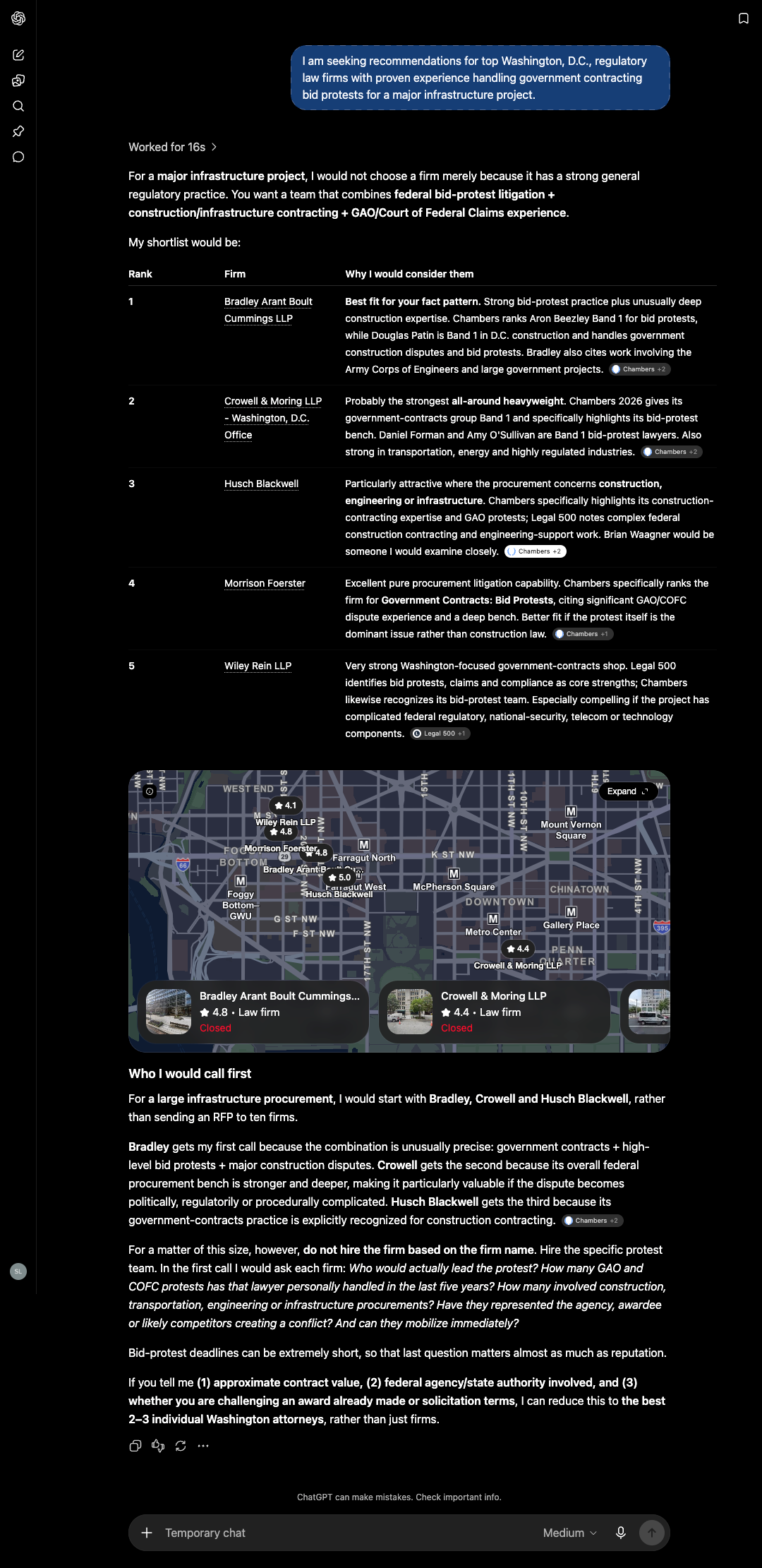
Someone asked ChatGPT for Washington, D.C. regulatory law firms with proven government contracting bid protest experience for a major infrastructure project.
ChatGPT did not send them to a directory.
It built a shortlist.
It named Bradley Arant Boult Cummings, Crowell & Moring, Husch Blackwell, Morrison Foerster and Wiley Rein. It explained why each firm fit the request. It pulled in Chambers and Legal 500 as proof. It added a map. Then it said which firms it would call first.
Are You Visible is my AI search visibility agency. I get businesses found when their customers ask AI who to trust, who to compare, and who to choose.
That is why this matters.
The answer was not traffic.
The answer was judgment.
A citybiz piece argued that AI search is becoming a second author of reputation for Washington law firms, trade associations, contractors, policy groups and other credibility businesses.
The screenshot makes the problem physical.
A buyer did not ask for a homepage.
A buyer did not ask for a slogan.
A buyer asked for help choosing.
ChatGPT answered with names, practice strengths, locations, outside proof and next-step advice. The firms that appeared were framed before the buyer ever reached their websites.
That is what AI reputation management means now.
It means the first serious impression may happen inside ChatGPT, Gemini or Perplexity before your website, your sales call, your referral partner or your polished bio gets a chance to speak.
If your business is missing, the buyer may never know it was an option.
If your business is present but described badly, the damage has already started.
If a competitor is named with a sharper reason, the shortlist has moved without you seeing it happen.
This is obvious for a regulatory law firm in Washington.
It is just as true for a wedding venue in Chicago, a roofing contractor in Phoenix, a private clinic in London, or a consulting firm that sells trust before it sells anything else.
The category changes.
The behaviour does not.
Do your customers look you up, compare you, or ask someone for a recommendation before they buy?
If yes, AI is now one of the places your reputation lives.
The first check is simple.
Open a Temporary Chat, then ask ChatGPT, Gemini and Perplexity the questions a real buyer would ask. Use your city. Use your category. Use the problem your customer actually has.
Do not run one query and declare victory.
Run fresh sessions across several days. Record who appears, how each business is described, which sources get cited, and whether your own business is absent, outdated or misunderstood.
That is the part most businesses skip.
They polish the website. They update the bio. They ask for reviews. They work on the things they can see.
Then a buyer asks an assistant, and the machine version of their reputation does the selling without them.
Or against them.
AI reputation management starts with knowing what the answer says.
Not guessing.
Knowing.
Sacha
September 15, 2026 · Issue #66
Get the next issue in your inbox: Get the Wire.
Sources
citybiz, “In Washington, AI Search Is Quietly Becoming the Second Author of Your Reputation,” September 8, 2026 - https://www.citybiz.co/article/899571/in-washington-ai-search-is-quietly-becoming-the-second-author-of-your-reputation/
Correction policy: If I get a fact wrong, I will correct the post and note the change here.
Go deeper
The AI Visibility Encyclopedia covers the full operational framework behind these signals, organic and paid, 48 chapters, free.
Read the encyclopedia →Published September 15, 2026