

Product feed, product pages and ChatGPT Ads · Started May 20, 2026 · Updated September 10, 2026
Lufi & Friends
Lufi & Friends: the feed recovery behind clearer Shopify product pages
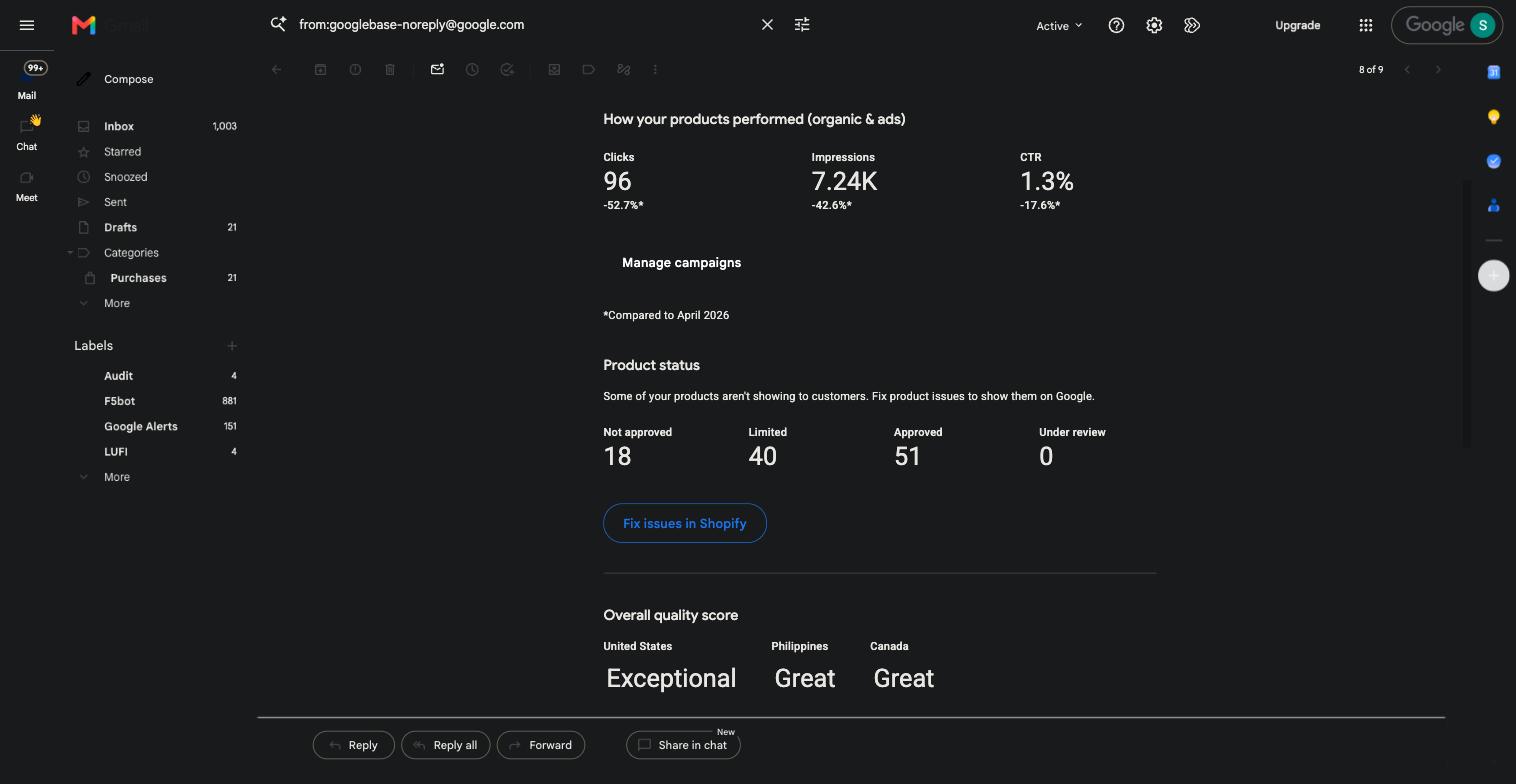
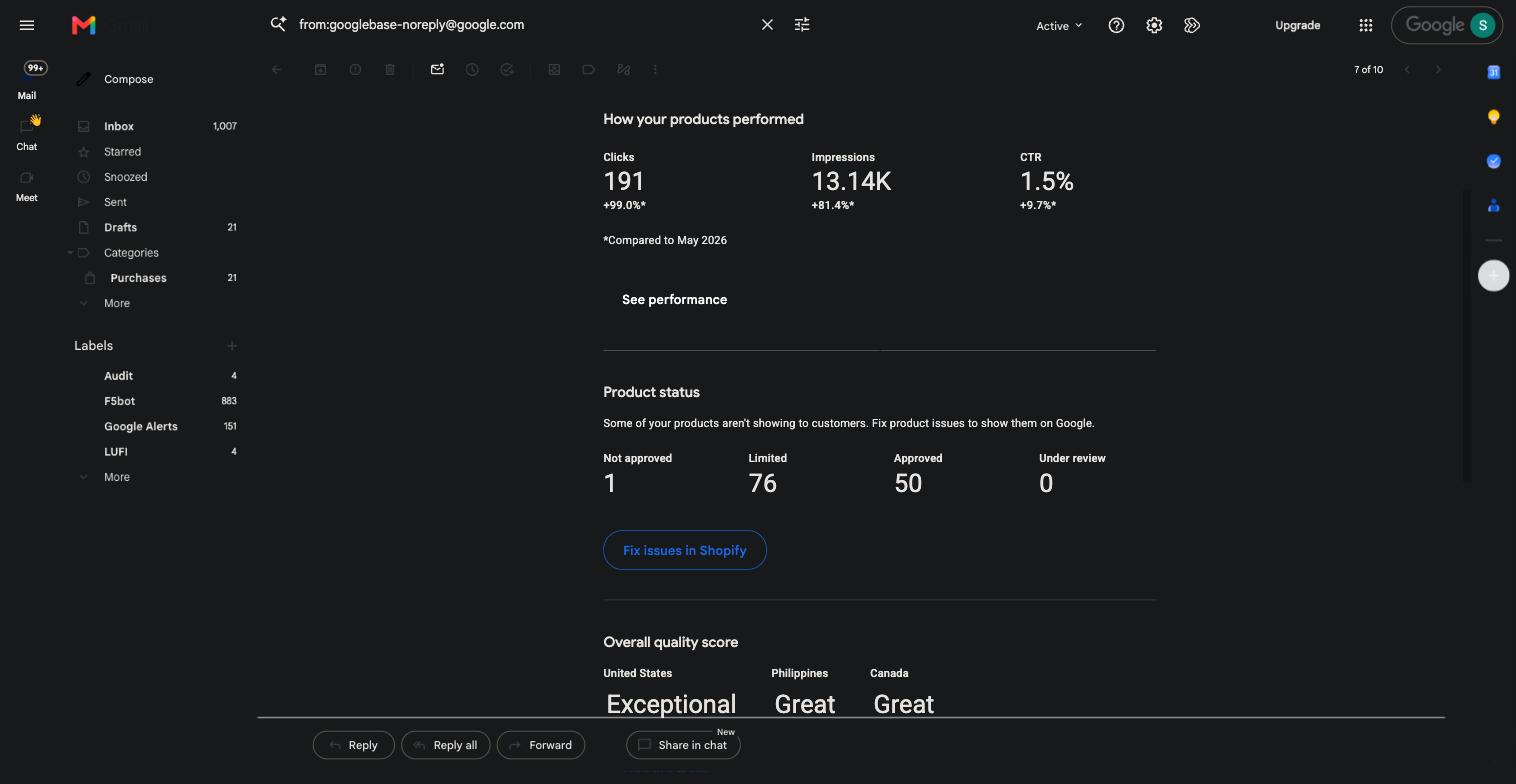
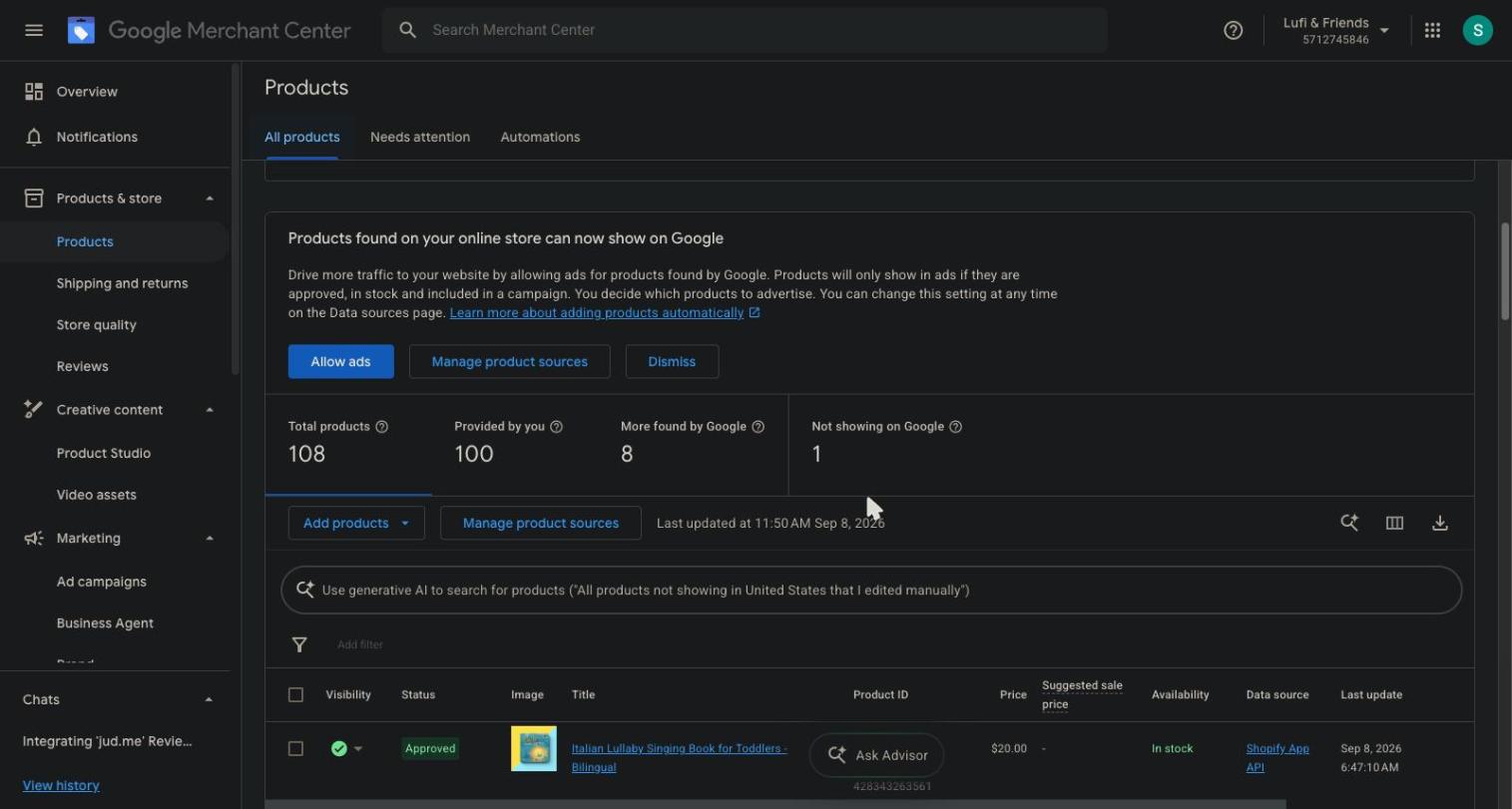
Google's own Merchant Center emails showed 18 products not approved in May 2026, the month clicks fell by more than half, to 96. One month later not-approved was down to 1 and clicks were back to 191, close to their April level. The product pages come next: 33 finished records across seven languages, staged for the store's new theme.
Ecommerce, Shopify, United States and Canada. Product feed, product pages and ChatGPT Ads. Work began 20 May 2026.
Where it stands
Every case is scored on the same three steps. Read: can AI systems reach and read the pages that matter? Trust: do the business’s facts match everywhere they appear? Recommend: do outside sources back the business up where AI looks?
| Step | Before | Now | Status |
|---|---|---|---|
| Read | AI crawlers allowed, but the book pages carried no product labels and the store counted no purchases | Purchase tracking live; product labels written for 33 books and staged for the new theme | In progress |
| Trust | 18 products not approved by Google; product records with blank fields; 438 reviews stuck on Etsy | 1 not approved; 33 records completed across seven languages; 623 reviews reconciled, 35 of the 36 low-star reviews answered, reviews showing on the product pages | Mostly done |
| Recommend | Not the first job | Not started. It comes once the product pages are live | Next |
Lufi & Friends is not ready to be recommended by AI yet, and this page does not claim it is. The foundations come first: the store has to be readable and its facts have to agree before outside sources can vouch for it.
What this proves
This is the ecommerce case. Not one missing tag. The whole visibility system was leaking: Google was rejecting the catalogue, revenue could not be measured, reviews were stranded off-site, Shopify Catalog was sending one version of the product, crawl-visible pages exposed another, and the first ChatGPT Ads test had no clean campaign structure yet.
The work joined the boring foundations to the commercial layer: feed repair, purchase measurement, multilingual product-page evidence, review objection mining, Shopify Catalog mapping and ChatGPT Ads testing. That is the part a website build alone usually does not cover.
The context
An Austin family business selling bilingual children’s books that play songs, about 63 products across nine languages. The starting audit found three things sitting on top of each other: Google’s May 2026 Merchant Center email counted 109 products, with 18 not approved, 40 limited and 51 approved; the analytics property we could access recorded zero purchases; and 438 reviews averaging 4.9 stars were sitting on Etsy where neither buyers nor machines could see them on the store’s own pages.
The paid account was also already running at scale. Auditing it campaign by campaign showed a healthy blended return hiding a very wide spread underneath: the best-performing campaign was returning more than 23 times its spend while capped at ten dollars a day, two profitable campaigns had been switched off, and the single largest line item was running at a return of 1.5. The cleanest signal was one video running in two places at once: a 3.95 return when optimised for purchases, 1.5 when optimised for add to cart.
Phase 1. Rebuilding the product feed
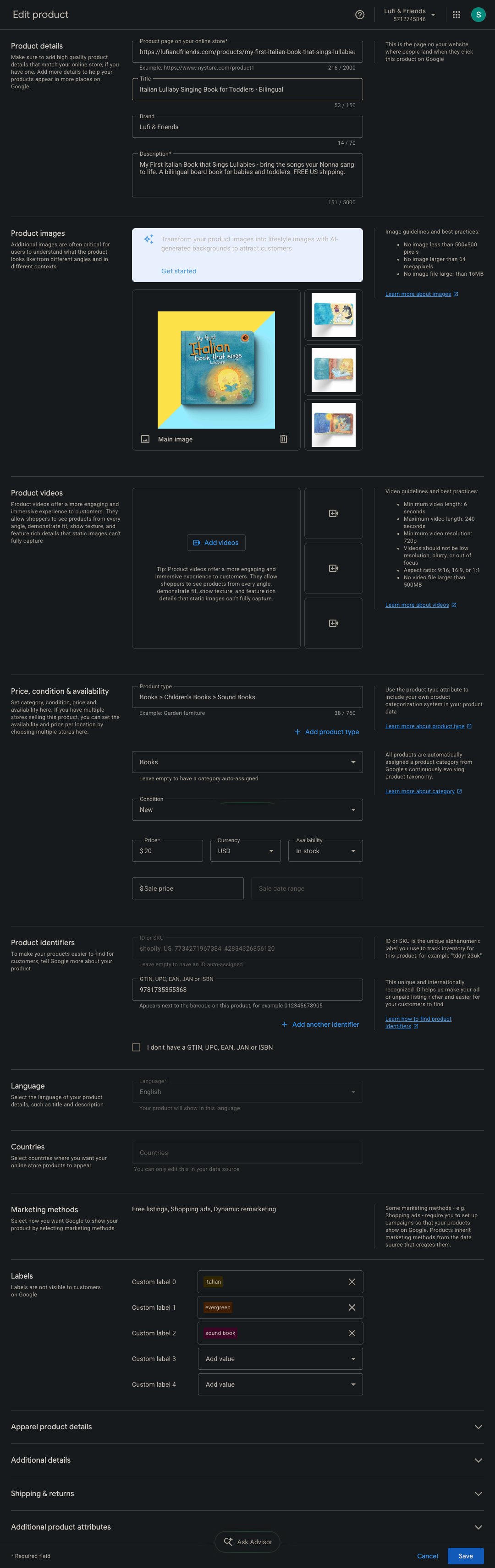
Matched the Merchant Center emails against the Shopify setup and found the source of the noise: Shopify Markets was pushing product data into countries the business did not ship to. Got the owner’s approval, then deleted both managed international markets while leaving the catalogue intact, removed 11 free printables and an archived bundle from the Google channel, and switched on shipping information sync.
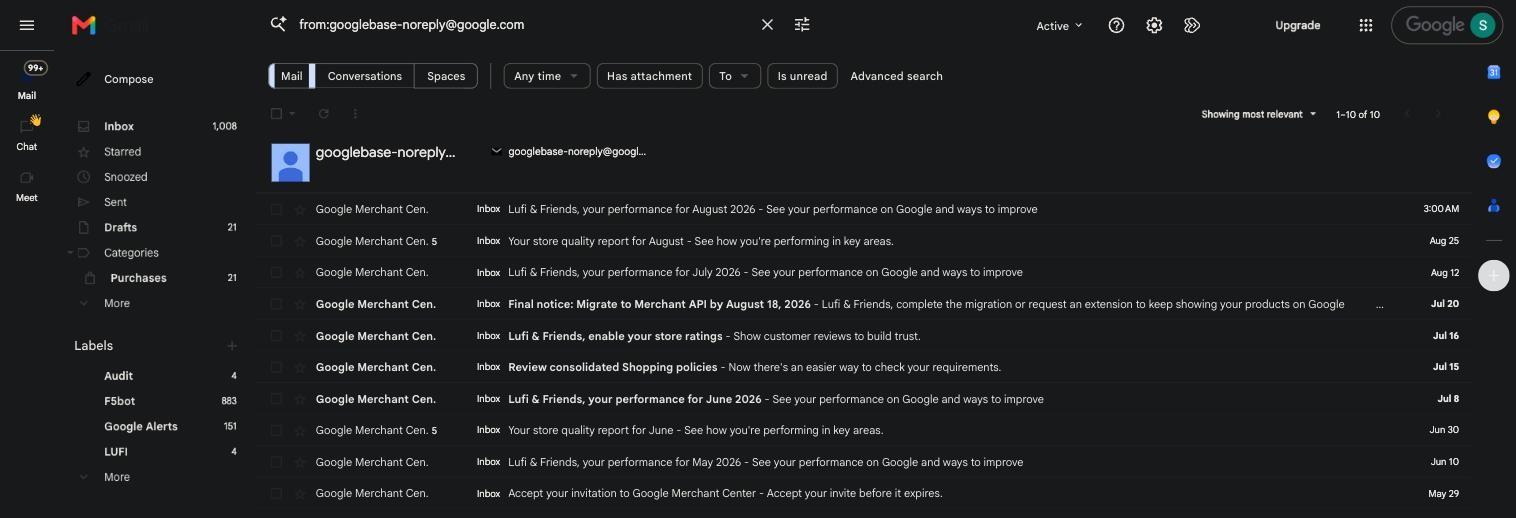
The feed stopped being a mystery. Google’s monthly emails show not-approved products falling from 18 in May to 1 in June, while Merchant Center clicks recovered from 96, less than half their April level, to 191. Later months held the recovery: 1 not approved in July, 2 in August, and August impressions reached 19.64K.
Phase 2. Making the revenue measurable
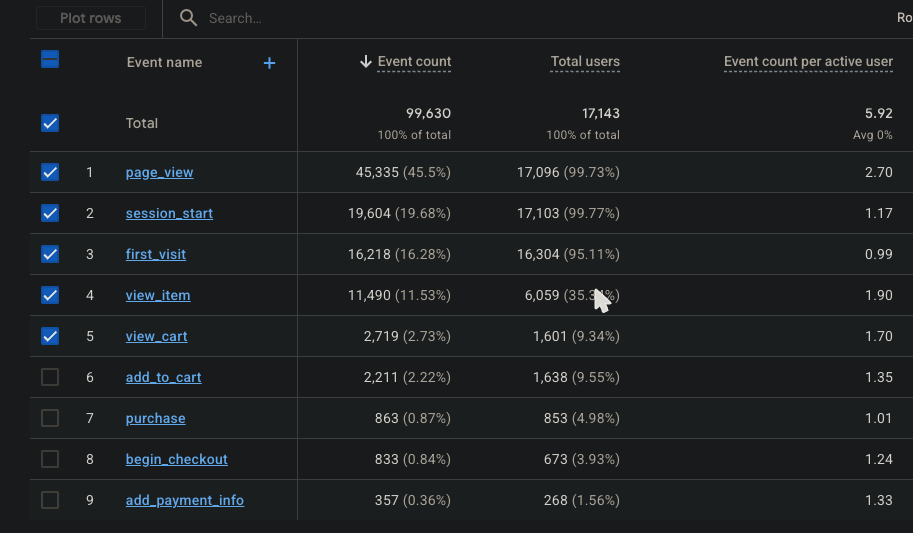
Built a Shopify Customer Events pixel sending add to cart, begin checkout and purchase with order value through the Measurement Protocol, and installed it on the property we control.
Verified firing live in the real-time view. The store went from counting visits to attributing revenue, so every claim after that date rests on measured sales.
Phase 3. Preparing 33 product pages across seven languages
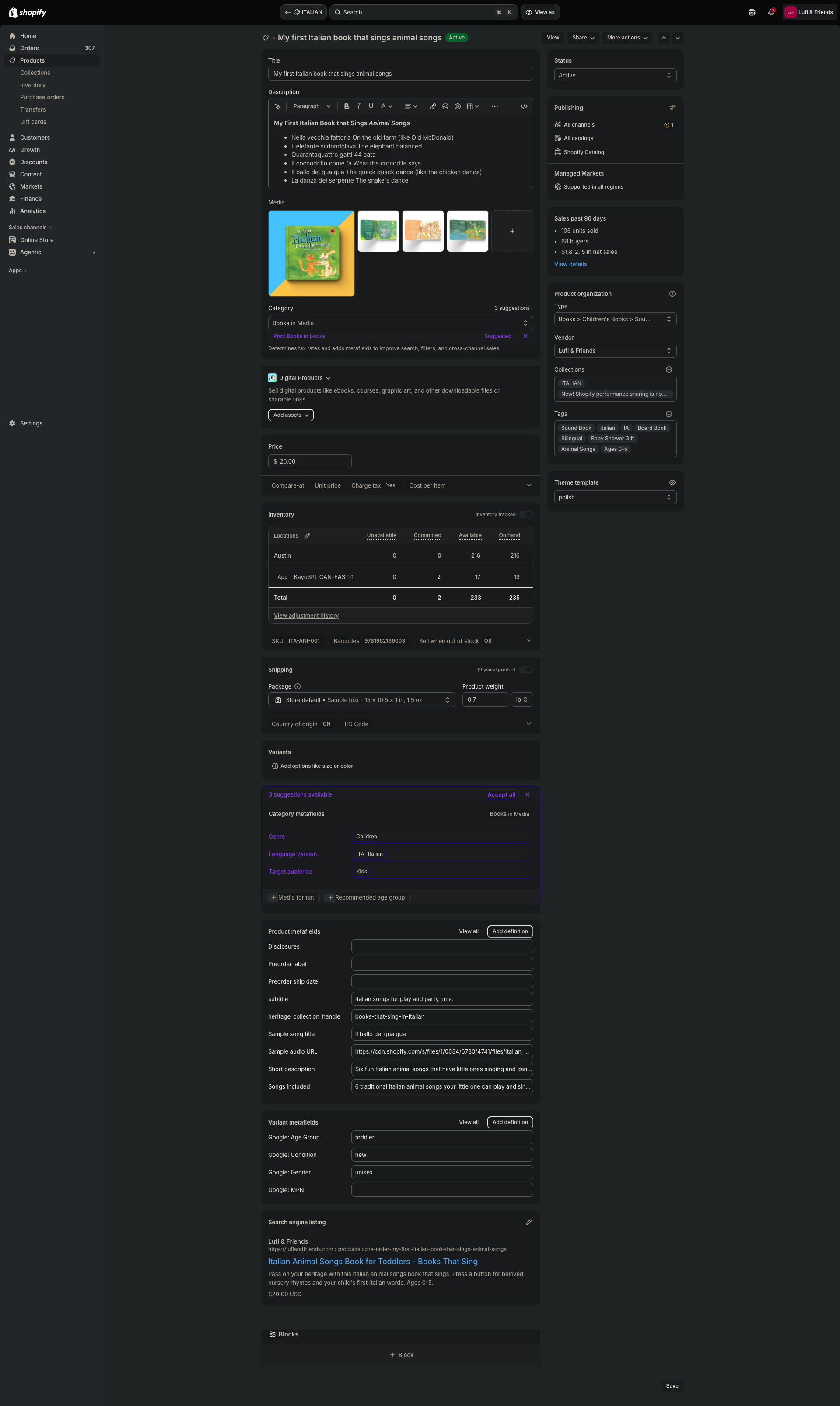
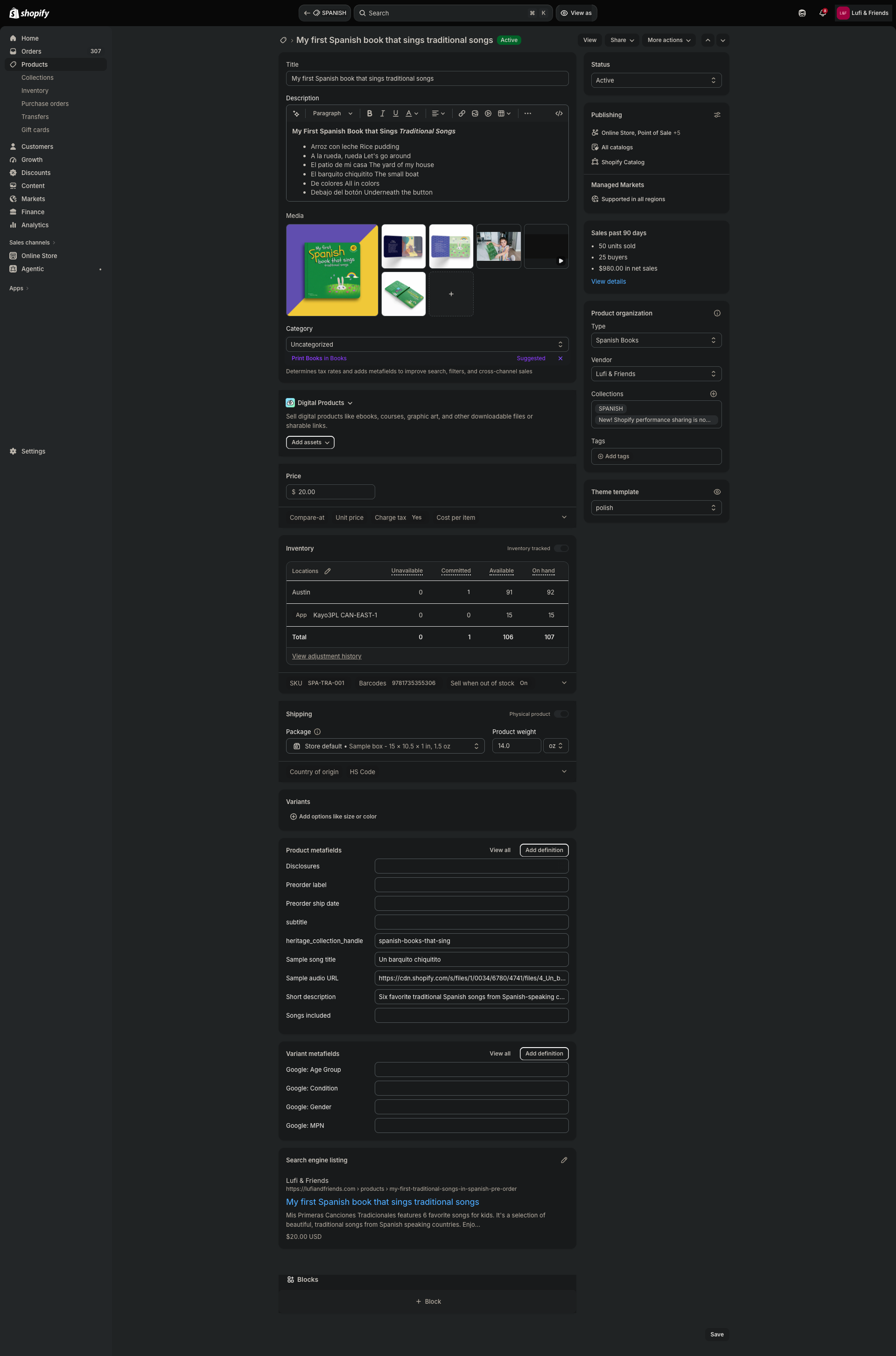
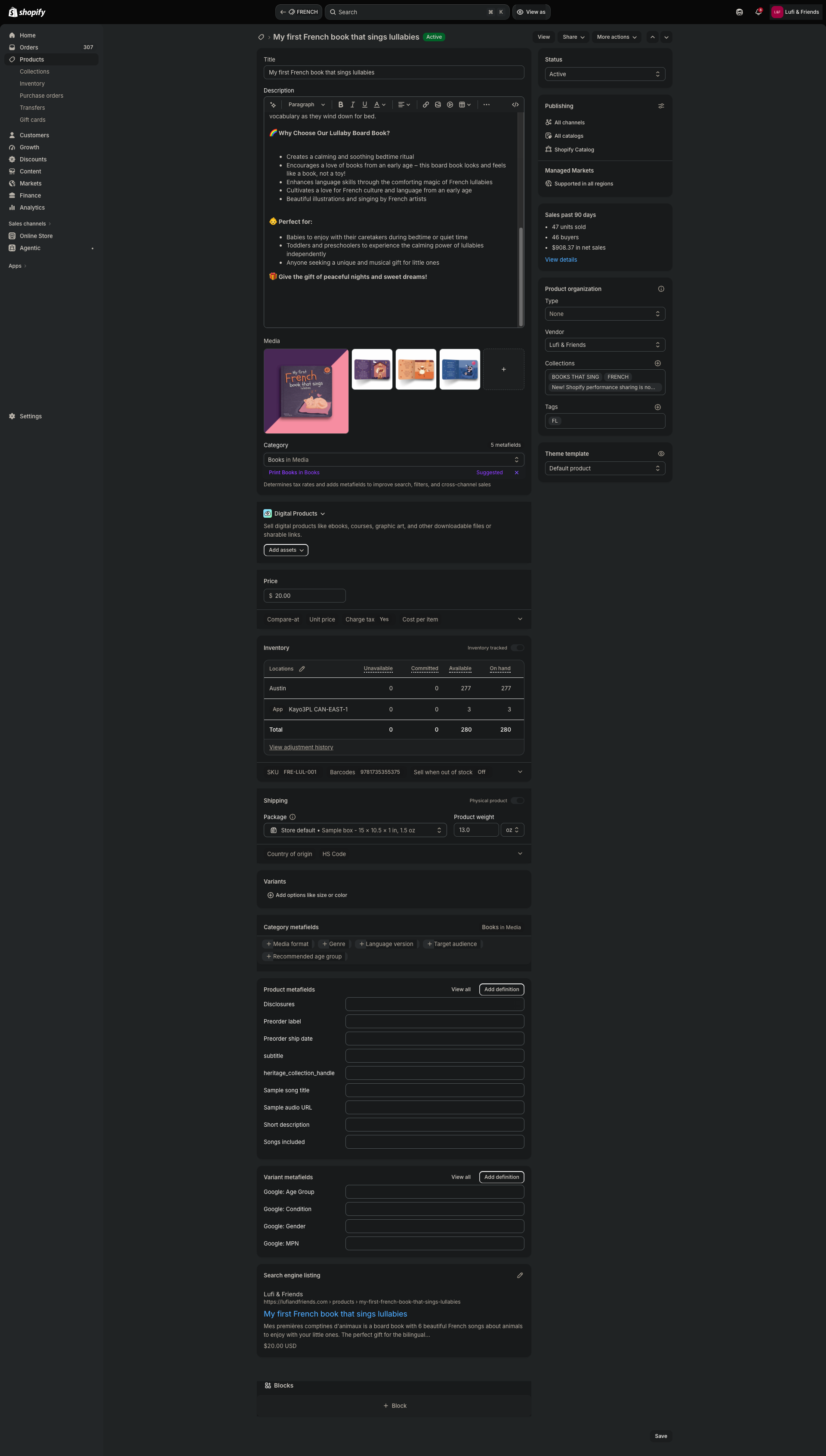
The product records showed the work in plain sight. One finished Italian product record had a real Shopify taxonomy category, tags, accepted category metafields, five content metafields and all four Google variant metafields. The Spanish and French records from the same store and same day still showed the before state: uncategorized or no type, no tags, and empty product fields.
Rather than fix that 33 times by hand, I built the generator and ran the catalogue through it. In parallel, read all 36 reviews below five stars out of 623, clustered them into five recurring objections, and answered those five on the page instead of leaving buyers to find them in the reviews.
33 book pages generated across Italian, Spanish, Polish, German, Russian, Ukrainian and French. Each is a complete record across three surfaces, the store fields, the Google feed attributes and eight types of structured data, each carrying the right heritage word for its language. All validated, delivered as one locked workbook per language, returned with the owner’s answers and staged for the store’s new theme, which has not launched yet.
Phase 4. Separating Shopify Catalog from the crawl
The important ecommerce finding was that there are two independent routes into AI. One is the feed: Shopify Catalog through Agentic Storefronts. The other is the crawl: ChatGPT reading the rendered pages on lufiandfriends.com. Treating them as one system led to the wrong diagnosis.
Shopify already showed ChatGPT as an earning channel, amount withheld here. The feed route was live. The crawl route was not: the pages were allowed by robots.txt, but still exposed almost no structured product data in the HTML. The next lever is not more generic copy. It is making the approved product facts visible in the exact places AI systems read.
Phase 5. The store’s first ads inside ChatGPT
OpenAI opened its ad platform to self-serve buyers in May 2026. The first combined campaign let one ad take about 90 per cent of the budget, so I split it into four campaigns carrying one message each and cut the maximum bid from $3.00 to $1.50 to keep clicks cheap while the test ran.
Best angle, three generations of a family singing the same songs: a 1.93 per cent click rate at 85 cents. Weakest angle 0.86 per cent, switched off. Confirmed independently in the store’s own analytics at 147 sessions in July and 116 in August, for about six dollars a day.
Two sales have been traced to the ads so far, on 29 July and 13 August, which does not pay for the test yet. ChatGPT’s unpaid answers have sold more: seven orders traced to them since the work began, five of them since the ads launched. Three more came in the two days before the work started, so I do not count any of them as a result. They show the channel is real for this store, and that is where the product-page work is aimed.
The results
The cleanest causal line is Merchant Center from May to June. Google’s own emails show not-approved products falling from 18 to 1 in one month, and clicks coming back from 96 to 191 as the rejections cleared. That is a recovery, not growth: May’s 96 was already down 52.7 per cent on April. By August, approved products had finally moved off the 50 to 51 range and reached 59, with impressions at 19.64K.
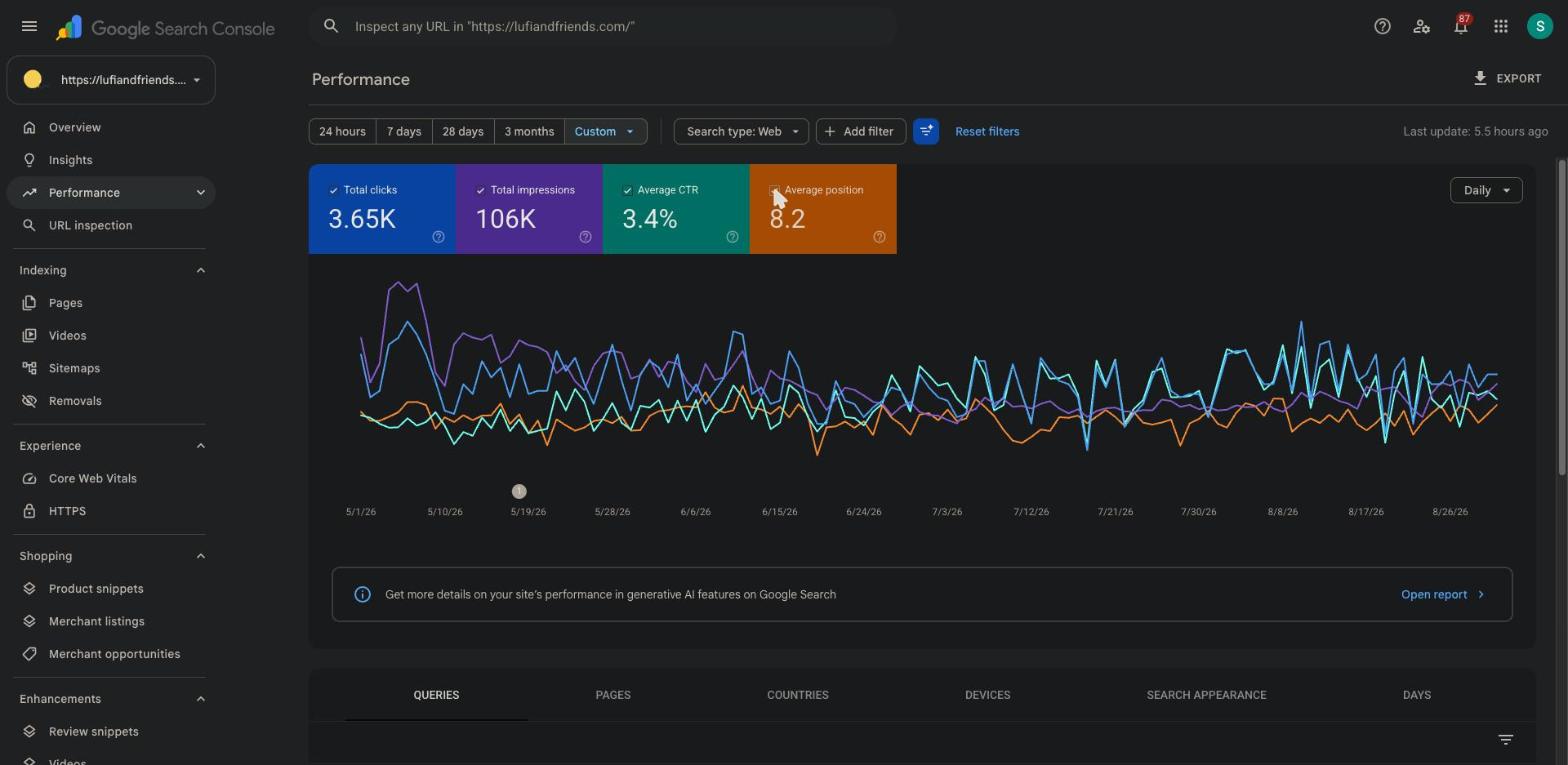
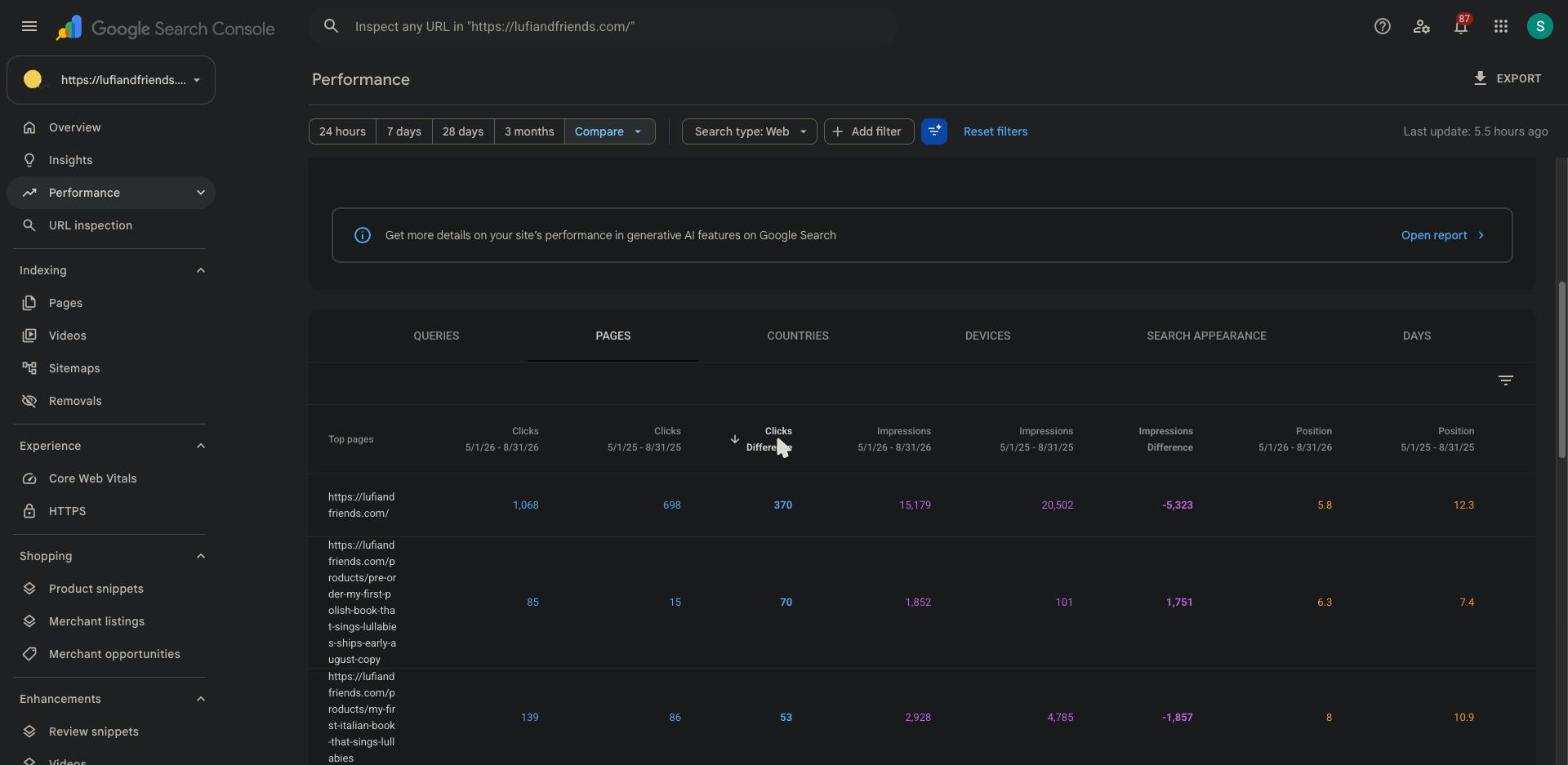
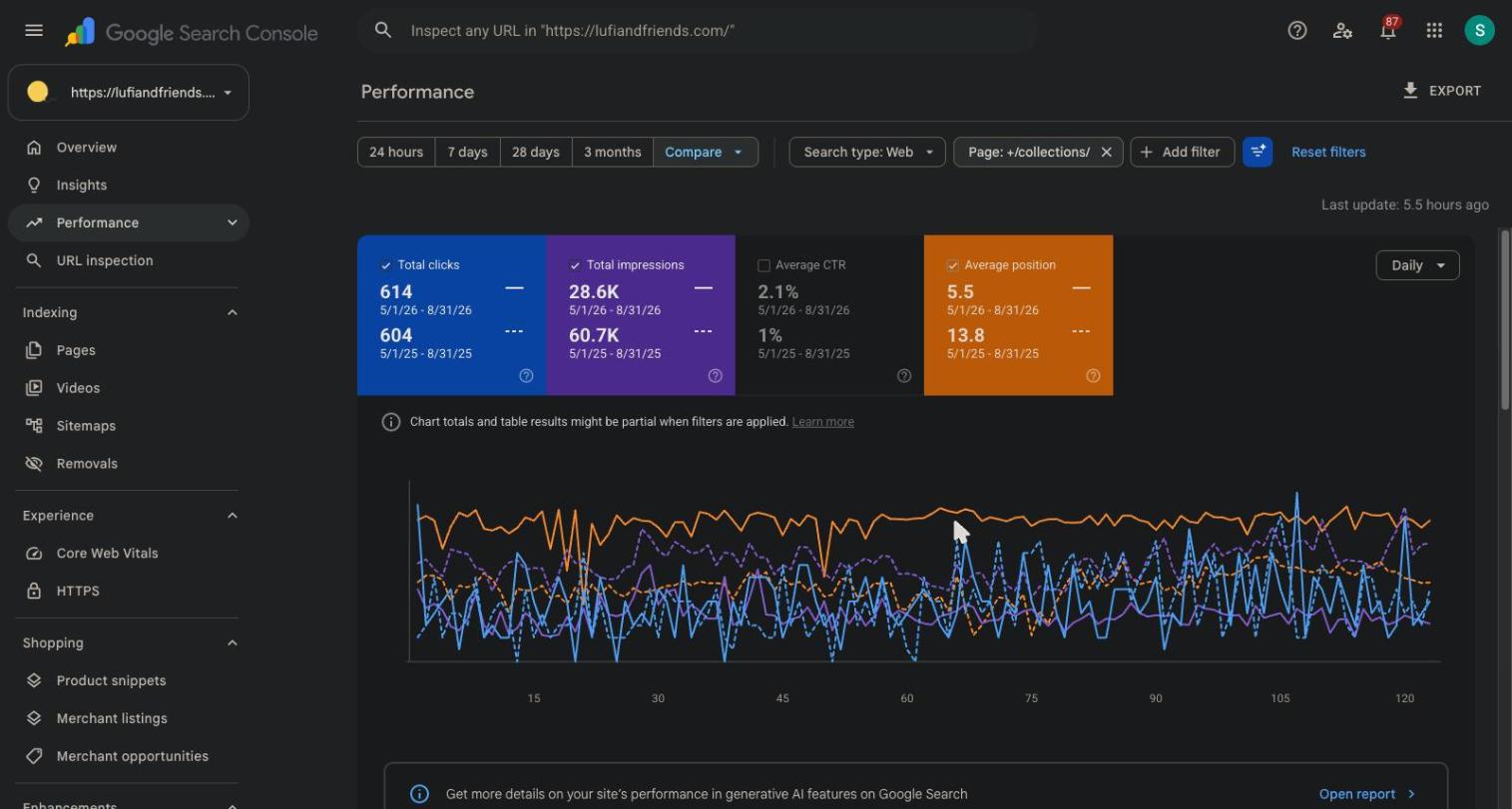
Search Console tells a separate story. Click rate rose every month from the start of the work, from 2.66 per cent in May to 4.31 in August. Read it with the table below: impressions fell by more than a third over the same months while clicks ended where they started, so the rate rose because Google showed the store less often, not because more people clicked. Average position went 8.3 to 8.1, which is to say it did not move much. The clean traffic win is the home page: 698 to 1,068 clicks year on year, while its average position improved from 12.3 to 5.8. The Russian collection is a ranking win, not a traffic win: clicks fell from 83 to 64, but average position moved from 13.1 to 3.3, the biggest ranking gain on the site.
This store sells gifts, so its year peaks at Black Friday and Christmas and bottoms out in summer. Its best click rate on record was November 2025, at 3.46 per cent. July and August 2026 both passed it, in what are normally the weakest months of the year. The same caveat applies: fewer impressions, similar clicks.
| Month | Click rate | Clicks | Impressions | Avg position |
|---|---|---|---|---|
| May 2026 | 2.66% | 988 | 37,120 | 8.3 |
| Jun 2026 | 3.27% | 841 | 25,699 | 8.0 |
| Jul 2026 | 4.10% | 824 | 20,080 | 8.5 |
| Aug 2026 | 4.31% | 996 | 23,097 | 8.1 |
The feed is clean, the product records are finished and waiting for the new theme, and the store can now measure what it earns.
What is still open
- The product pages are staged, not live. On 10 September 2026 the store’s book pages still carried no product labels for AI crawlers to read. They go live with the new theme.
- AI recommendation is the next step, not a result. Once the pages are live, the work moves to the outside sources assistants check before they name a store.
- The ads have not paid for themselves yet. The test answered which message gets clicked; the sales are still to come.
Evidence
Each screenshot below is the source, with only empty margins cropped. The line under it says what it shows. Open any of them full size to check the numbers.
Sources. Google Search Console for lufiandfriends.com. Google Merchant Center, diagnosed 3 June, rebuilt 4 June, re-verified live in June and September 2026. Shopify Agentic Storefronts and Catalog Mapping review, 8 September 2026. Shopify orders matched on the link tags ChatGPT adds to its answers and to the ads, 18 May to 10 September 2026. OpenAI Ads account, verified live 17 July 2026. Google Analytics. Fera reviews export. A live check of the store’s book pages on 10 September 2026. Client revenue and advertising spend are withheld.
Lufi & Friends agreed to let this engagement be written up here. Client revenue and advertising spend are withheld. The site audited was https://lufiandfriends.com.
Lufi & Friends: if you would rather this came down, email support@areyouvisible.co and it is removed the same day, no questions asked.
Not Lufi & Friends?
Same questions, same method, on your own site. I run it, then walk you through what ChatGPT, Gemini and Perplexity say before you pay anything.
Check your visibility